Posts

Showing posts with the label research

Join Forrester and Google for a conversation about the real-time opportunity in retail SEM

There’s no doubt that technology continues to transform the pace of business. In the past, it wasn’t possible to track online conversions back to ads in real-time. You couldn’t always be sure you were advertising only in-stock items or immediately traffic out seasonal assortment changes. But now advanced digital marketers are able to take advantage of real-time conversion and product data in their advertising campaigns to great effect. Forrester recently completed a global study of 240 retailers’ search campaigns. What they found was… opportunity. Most retailers still don’t take advantage of existing real-time capabilities in digital marketing, and leave a significant opportunity for savvy marketers who do. Come hear Forrester and Google talk about:  Results from Forrester’s retail search study  Insights about the retail search market, and where you can take advantage  How to become more “real-time” in your own digital advertising  Speakers: Shar VanBoskirk, Princip...

Happy Omnidays!

Image
December of 2014 may be remembered as the first truly omni-channel holiday season: the year retailers really stretched the sales funnel to include mobile, store visits and online buying under one big connected holiday umbrella. Let's take a break from the holiday dash to see what we can learn from companies that have been creating unified shopping experiences for consumers while ringing in bigger and better profits for themselves. We'll start with a salute to three great examples of omni-channel thinking: Macy's , Sephora and REI . Macy's  When over 15,000 people streamed into Macy's main New York City store at 6 pm this Thanksgiving Day, CEO Terry Lundgren wasn't too surprised. Omni-channel helped put those shoppers there. “So far, people are gravitating to the doorbusters," Lundgren said the next day. "There’s so much information online, so they’re doing that research and going right for those doorbusters." 1 Macy's has been working for yea...

How Local Retailers Can Use Digital to Connect With Consumers

Image
Conventional wisdom suggests that the rise of digital is making local retailers obsolete. But the reality is much different—technology actually presents new opportunities to help savvy retailers connect with consumers, drive them to the store and increase sales. To better understand the impact of smartphones and online information on in-store shopping, Google partnered with Ipsos Media CT and Sterling Brands to conduct an online survey. With this new research, we were able to uncover the real relationship between digital and local retail, as well as debunk three common retail myths. Myth: Search results only send consumers to e-commerce sites. The Reality: Search results are a powerful way to drive consumers to stores. Many retailers believe that when shoppers look for products online, they limit their research strictly to e-commerce websites. In reality, three out of four shoppers who find local information in search results helpful are more likely to visit stores. When information ab...

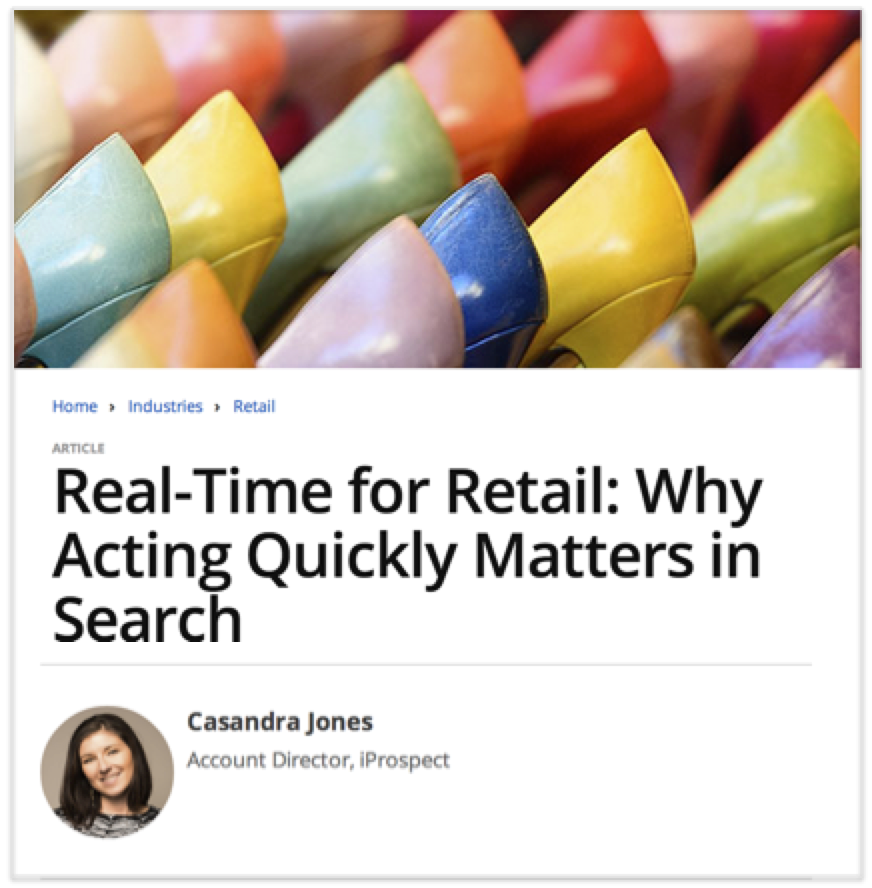
Real-time in retail: Why acting quickly matters in search

Image
(Cross-posted from the DoubleClick Search Blog ) When consumers act, they act fast. Retailers can get a leg up in the marketplace by responding to consumers’ needs as they surface. While some events, such as holidays and championship games, can be anticipated, others, such as weather-related issues, cannot. Using real-time technologies in search, brands can dynamically adjust their reach, competitiveness and relevancy with their target audiences at the most critical times. In a new Think Insights article, Casandra Jones, Account Director at iProspect, tells us the benefits of adopting SEM tools that act in real time to achieve search success as these important events and conversations occur. Check out Casandra’s article on the Think Insights page here , and let us know what you think on Twitter or our Google+ page .

Proof That Online Search Ads Can Boost Offline Store Sales

Can online search ads impact offline store sales? The connection seems counterintuitive, but the answer is a firm "yes." A milestone meta-analysis of experiments with 13 top U.S. retailers, conducted by Applied Predictive Technologies, proves that search ads drive incremental offline sales. Results vary by industry and advertiser, but the research offers guidance for multi-channel retailers: Create a seamless connection between your channels and use digital to efficiently drive sales across the board.  To read the full article visit Google Think Insights .  Posted by Nina Thatcher, The Google Technology Team

2013 Holiday Shopper Intentions: Peering Through the Digital Window

This is the year the store window goes digital. According to our new research, conducted with Ipsos, more people are researching and purchasing holiday gifts online than ever before. They’re also shopping across screens and channels, looking for great deals, and starting earlier than before. So, with the holiday season already underway, we take a look at these and more trends marketers should know for 2013, including the hottest products on Google. Head on over to Google Think Insights to read a summary of the research and download the top stats .

The Lap of Luxury: How Affluent Shoppers Buy Luxury Goods

How do shoppers use digital to research and buy luxury goods? Google teamed up with Ipsos to reveal how affluent consumers shop for high-end fashion, accessories and jewelry. We found luxury buyers are digital-savvy: They are multiscreen consumers, they use the internet more than any other medium for research, and most still make their purchases in a store. To learn learn more about luxury shopping behaviors, access the Lap of Luxury Infographic or full study on Google Think Insights .   Posted by Katrina Echt, The Google Fashion Brands Team

Reaching the mobile phone shopper

Image
Demand for mobile phones shows no signs of slowing down - in fact, according to one study smartphone subscriptions in the US increased by 50% year over year in 2012*. There are many ways to purchase a phone today, and even more choices and options that come with it. To better understand how people shop for mobile phones, Google teamed up with Compete to look at shopping patterns for mobile phones and how they have changed over the past year. Here are some highlights from our findings: Devices drive more purchases; less buy to upgrade Year over year, 25% more consumers purchased a phone to get the latest and greatest device while 9% less purchased because they were eligible for an upgrade. In fact, 1 in 3 smartphone buyers select a phone first, then a carrier. More choices, more online research The proliferation of non-exclusive devices at carriers has resulted in more switching, brand uncertainty and cross shopping. One in 3 shoppers switched carriers (up 39% YOY) and nearly half (4...

Ushering in the first Nonline holiday shopping season

Image
How many times have you started searching for a new pair of shoes on your smartphone while waiting in line, continued your research on your laptop when you got home, and then searched online to find a local store that has those shoes in stock? Today, people no longer see a line between online and offline shopping, and neither do smart retailers. This year online and offline shopping experiences are more seamless than ever before - across pricing, functionality, and promotions - making this the first Nonline holiday season. Not only is this the first Nonline holiday season, but it’s an important one for retailers as consumers prepare to spend more money -- and spend more time making sure they get the most value for every dollar spent. Our research released today with Ipsos shows that on average, shoppers plan to spend $900 on holiday shopping this year, up slightly from an average of $854 last year. Along with this bump in spending, we’re seeing an increase in research before purchasing...

Google/Compete Shopper Study: How Consumers Shop for Tablets, Laptops & Ultrabooks

Image
Google and Compete recently completed the Portable PC Shopper Study to better understand the purchase decision journey for tablet, laptop and ultrabook shoppers. Here are a few highlights from our research: Tablet, Laptop and Ultrabook shoppers are triggered to shop for different reasons. The top 4 reasons why consumers purchased a device were: They wanted a smaller/lighter device (tablets & ultrabooks indexed higher here) They needed to replace a lost/broken device (laptops indexed higher) They wanted to upgrade their device They purchased based on impulse - they just had to have it Overall, these triggers were pretty even when looking at data aggregated across portable PCs. Ultrabooks & tablets indexed higher against smaller/lighter device and impulse. Laptops indexed higher against replacing a lost or broken device. When they start shopping, Portable PC shoppers are often undecided on a brand or retailer. Portable PC Shoppers use digital sources to inform decisions through...

Digital’s Role in the Furniture Shopper’s Path to Purchase

Image
It’s no secret that the way consumers shop today has fundamentally changed. Purchase decisions are highly researched and much more calculated than they were ten years ago. According to a 2011 Google/Shopper Science study, the number of sources used by any shopper for any average shopping occasion is now up to 10.4. This is nearly double the amount used as recently as 2010! So what’s the impact to furniture retailers? According to Forrester research, 6% of furniture sales will be e-commerce by 2016, and 60% of all furniture sales will be online-influenced. To better understand the role that online plays in furniture shopping, we investigated into how digital and mobile influences the furniture purchase path. Check out this infographic to see some of our key findings: Stay tuned for more great insights into the furniture category, including data around the consumer's online path to purchase, later this year. Posted by Jacalyn Stolt, Google Retail Team

Introducing the ZMOT Handbook: Ways to Win Shoppers at the Zero Moment of Truth

Image
(Cross-posted from the ZMOT Blog) "Showing up is 80% of life." - Woody Allen As Woody Allen opens, showing up is a big part of life. And as we’ve seen with the Zero Moment of Truth, showing up with at the right place with the right content is a big challenge in today’s marketing landscape. To help marketers apply the principles of the Zero Moment of Truth, we’re introducing The ZMOT Handbook , a new online resource that shows exactly how to show up at the right place with the right content and win shoppers. You can download the ZMOT Handbook right now, right here . This new book is the much-requested followup to Winning at the Zero Moment of Truth , the 2011 ebook that's been downloaded over 200,000 times. While ZMOT is being universally embraced as the new critical moment for brands, many marketers are wondering how to get started. The ZMOT Handbook provides practical tips on how to apply ZMOT principles to your marketing strategy, along with detailed insights from Todd...

Smartphones and Tablets Influence Consumer Purchasing Decisions on Mobile, Online and in Store

Image
(cross-posted on the Google Mobile Ads Blog ) Retailers are largely focused on how consumers are shopping across channels and devices. We know consumers love their mobile and tablet devices, but we are just beginning to develop a strong understanding of how they engage with these devices as they make their purchase decisions. To gain greater insight into this key behavior, we partnered with Ipsos during the 2011 holiday shopping season to study online shoppers. We uncovered a number of interesting consumer behaviors across desktop computers, smartphones and tablets. The powerful data we uncovered can drive best practices for advertisers at every holiday and year round. The first key mobile insight every advertiser should know is that consumers use their smartphones at many different points in their purchase path. 41% of those who used their mobile phones to help with shopping said they made a purchase directly on their smartphone. 46% said they researched an item on their smartphone th...

Google/Compete Study: Digital’s Influence Over the Wireline Service Shopper

Between my husband and I, we have 14 devices that connect to some type of wireline service. And with a new batch of cool gadgets clamoring for our attention during the holiday season, that number is sure to grow. Not just for us, but for the millions of other consumers lining up to buy TVs, tablets, laptops and so on. On Black Friday this year, nearly 40% of shoppers purchased electronics and TV purchasers increased by 30% . With all those new, shiny and sleek electronics flooding the market, many consumers are looking to upgrade their current wireline services. So what good is the piece of hardware without the service provider to deliver the content? And, more importantly to the bottom line of cable TV, high-speed internet and home phone service providers, how are consumers finding the information to make those purchase decisions? In Google’s new custom research study with Compete , we looked at the surprising and powerful role digital and mobile play in influencing wireline servic...

Google/Compete Study: How Digital Influences the Toy Shopping Process

‘Tis the season for toy shopping. Fijit Friends , Leap Pads , Monster High Dolls , and of course, Lego , Barbie , and American Girl Dolls are top of the list this year. We’ve already seen toy queries increase 38% in 2011 versus 2010. And we all know that November and December are key times for toy shoppers (see query trends here ). As the online channel becomes increasingly influential, many toy retailers and manufacturers are asking how to best reach these shoppers. We’re excited to announce that Google and Compete recently completed a custom study on the Toy industry, investigating how digital and mobile influences toy purchase decisions. Here are 4 key insights and recommendations on how marketers can reach toy shoppers this season! Digital is core to the toy buying process: Digital resources are used more throughout the toy purchase cycle than traditional sources. 43% of shoppers use video sharing sites, 39% visit manufacturer websites, and 39% rely on paid search for inf...